
Botanical Characteristics and Biology of the Kratom Plant
The kratom plant, known scientifically as Mitragyna speciosa1, illustrates the diversity of tropical flora. It belongs to the Rubiaceae, or coffee family, and is therefore related to the coffee plant2. This evergreen to facultatively deciduous tree grows in the humid forests and wetlands of Southeast Asia and is adapted to changing environmental conditions34.
This article provides a research-based introduction to the botanical characteristics and biological processes of the kratom plant, drawing on current studies and field observations25. It examines how Mitragyna speciosa grows in its natural environment and describes features ranging from its oval-lanceolate leaves to regional variation in growth and alkaloid profiles46.
Habitat and distribution: a tree of tropical wetlands
Mitragyna speciosa is a tropical tree native primarily to humid regions of Southeast Asia12. Published botanical sources report the species in Thailand, Malaysia, Indonesia—especially Sumatra, Borneo and Kalimantan—and parts of Myanmar, the Philippines, Cambodia, Vietnam and Papua New Guinea. It is associated particularly with riverbanks, freshwater swamps and seasonally flooded wetlands237.
These habitats combine high moisture with nutrient-rich alluvial soils containing abundant organic material. Periodic flooding can support dense stands in suitable locations24.
Botanical research indicates that kratom trees commonly occur where groundwater saturates the soil for eight to ten months of the year2. The species tolerates waterlogged conditions unusually well, while insufficient irrigation can inhibit growth rapidly2. During drought, above-ground growth may wilt or die back while surviving roots later produce new shoots from the base of the trunk2.
Mitragyna speciosa is described as facultatively deciduous: it can shed its leaves in response to environmental conditions. This provides a means of adapting to dry periods in variable tropical climates24.
The natural range extends across Peninsular Thailand, Malaysia and parts of Vietnam, while related species in the genus Mitragyna occur as far away as Africa and India17. Growth varies considerably within Thailand. Trees reach their largest dimensions in the southern core habitat along the western and eastern coasts, while specimens in northern and north-eastern regions tend to remain smaller4.
Between 2018 and 2020, Thailand’s Narcotic Crop Survey and Monitoring Institute analysed more than 745 kratom samples from different regions and documented substantial geographical differences in growth and alkaloid concentration4.

Morphology: leaves, flowers and growth
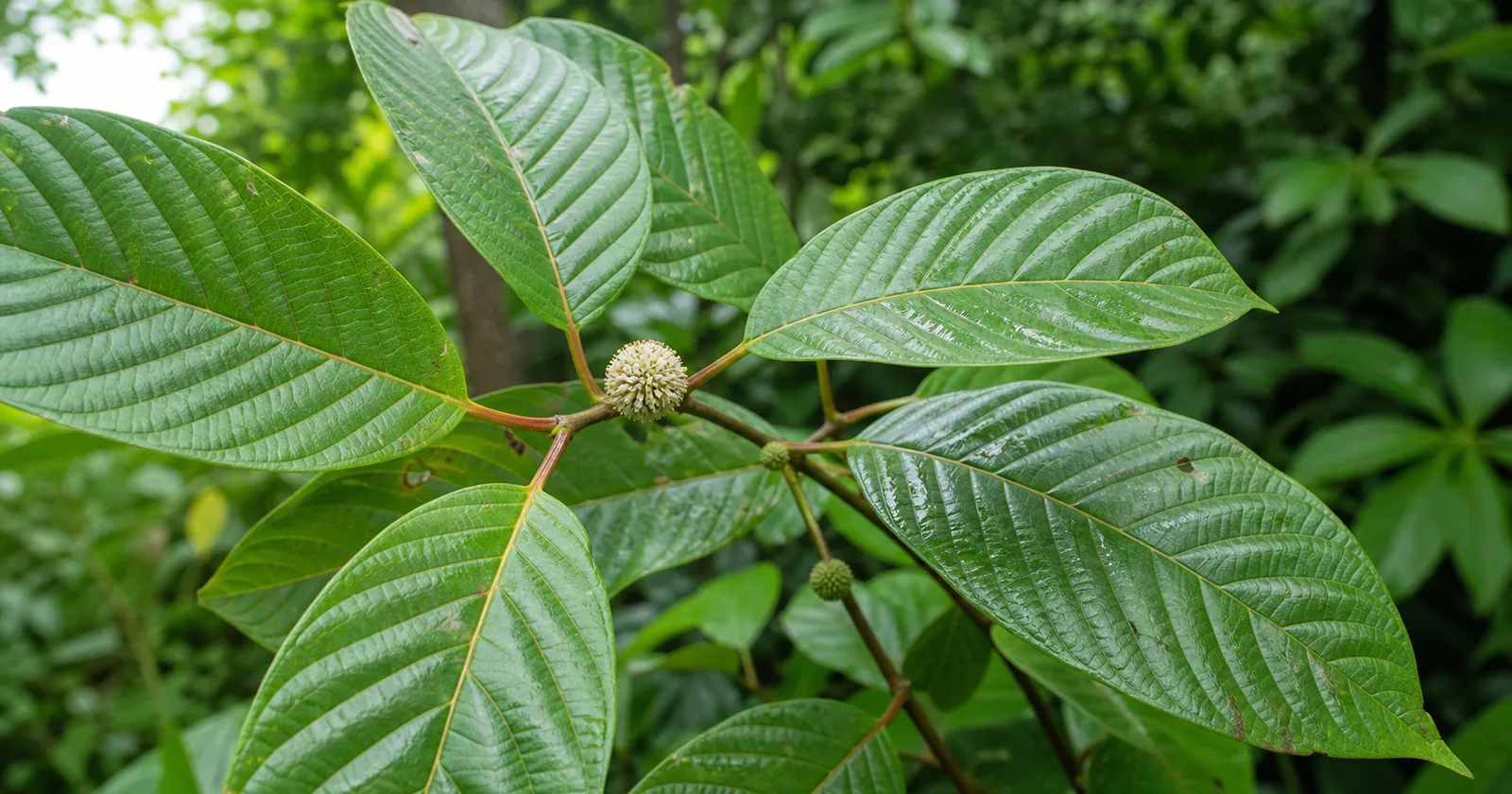
The leaves of Mitragyna speciosa are oval to oval-lanceolate, dark green and can reach approximately 180 mm in length and 100 mm in width2. One study reported an average mass of about 1.7 g for a fresh leaf and approximately 0.43 g after drying6.
Leaf veins display colour variation and may appear greenish-white, green or red. These characteristics have traditionally been used to classify commercial types. Claims that vein colour alone reliably predicts chemical potency, however, are not supported by a single consistently standardised scientific classification48.
Studies of leaf development show that morpho-physiological properties are linked to photosynthetic capacity and alkaloid concentration6. Researchers have described five growth stages:
- S1: 7–15 days
- S2: 15–30 days
- S3: 30–45 days
- S4: 45–60 days
- S5: 60–75 days
Leaf mass and area increased continuously from S1 to S4 in the cited work, followed by a slight decline in S56. Chlorophyll and carotenoid levels rose through S5, while the maximum photosynthetic assimilation rate was reached earlier, during stages S2 and S36.
The yellow, spherical inflorescences contain as many as 120 individual florets. They develop into capsule-like fruits holding numerous small, flat seeds2. Mitragyna speciosa can reproduce readily by seed where seeds fall onto persistently moist soil, contributing to local spread in suitable habitats2.
Alkaloid profile and chemical variability
Kratom has a complex and variable chemical composition. More than 40–50 alkaloids have been reported in Mitragyna speciosa, while the total alkaloid concentration in dried leaves is often cited in the range of 0.5–1.5 per cent159. Values depend on the sample and analytical method.
In Thai plant material, mitragynin (MG) is commonly the dominant constituent and has been reported to account for up to 66 per cent of total alkaloids. 7-Hydroxymitragynin (7-HMG) is normally a minor component, reported at up to approximately two per cent in the cited sources48.
Metabolomic and phytochemical studies indicate that the alkaloid profile depends on several factors356:
- Age and developmental stage: younger leaves can accumulate more corynantheidine and speciociliatine, while mature leaves have shown the highest mitragynin levels in some studies56. Mitragynin concentrations have also been reported to increase with tree age, with younger plants showing lower levels than older trees in the studied samples4.
- Geographical origin: comparative studies have found higher mitragynin concentrations in some Thai samples than in Malaysian material48. A Thai survey reported values ranging from 0.39 to 3.46 per cent according to region, with the highest measurements in southern provinces4.
- Environmental factors: temperature, soil composition, light intensity, moisture and harvest timing can influence alkaloid production35.
- Seasonal variation: significant seasonal fluctuation has been reported, including variation in 7-hydroxymitragynin measurements3.
Harvesting and processing
Commercial cultivation in Southeast Asia takes place predominantly outdoors. One cultivation guide describes planting densities of approximately 1,000–2,000 trees per acre2. Regular pruning can maintain vigorous growth and keep foliage within a practical harvesting height2.
Post-harvest processes—including wilting time and drying temperature—can substantially influence the measured alkaloid profile:3
- Lower drying temperatures of 25 °C preserved mitragynin, speciogynine and paynantheine most effectively under the conditions of the cited study3.
- A twelve-hour wilting period before drying at 25 °C was associated with a 37–48 per cent increase in speciogynine concentration in that experiment3.

Conclusion: a plant with complex biology
Research on Mitragyna speciosa describes a plant with complex biology and pronounced adaptation to tropical wetlands25. Its morphology, environment, age and post-harvest treatment can all contribute to chemical variability35. Analytical results therefore characterise a specific sample rather than every plant or commercial batch.
Sources and scientific literature
- European Union Drugs Agency (EUDA) (2024). “Kratom drug profile”. https://www.euda.europa.eu/publications/drug-profiles/kratom_en
- University of Florida, Institute of Food and Agricultural Sciences (2025). “Kratom: Botanical Insights and Cultivation Practices…” https://edis.ifas.ufl.edu/publication/EP653
- Zhang, M. et al. (2025). “Alkaloid biosynthesis in medicinal crop kratom…” Frontiers in Plant Science. doi:10.3389/fpls.2025.1653916
- Sengnon, N. et al. (2023). “Seasonal and Geographic Variation in Alkaloid Content…” Plants. doi:10.3390/plants12040949
- LaForest, L. C. et al. (2023). “Metabolite and molecular characterization…” Journal of Natural Products. doi:10.1021/acs.jnatprod.3c00092
- Phromchan, W. et al. (2024). “Morphological and physiological properties…” Plant Science Today. Article
- Meireles, V. et al. (2019). “Mitragyna speciosa: Clinical, Toxicological Aspects…” Medicines. doi:10.3390/medicines6010035
- Boffa, L. et al. (2018). “Alkaloid Profiles and Activity…” Natural Product Communications. doi:10.1177/1934578X1801300904
- León, F. et al. (2009). “Phytochemical Characterization…” Natural Products Communications. PMC9255435