
What Is Kratom? Plant, Origin and Research Overview
Kratom is the common name for the leaves of the tropical tree Mitragyna speciosa. The species belongs to the Rubiaceae, or coffee family, and is native to Southeast Asia123. This evergreen tree occurs particularly in Thailand, Malaysia, Indonesia, Myanmar, the Philippines and Papua New Guinea, where it forms part of the regional flora124.
In commercial contexts, “kratom” usually refers to dried leaf material from Mitragyna speciosa sold as a botanical product56. This article explains what kratom is botanically, where it originates, which plant constituents have been studied and how international research and regulatory discussion currently approach it167. It is factual information and does not recommend consumption or use.
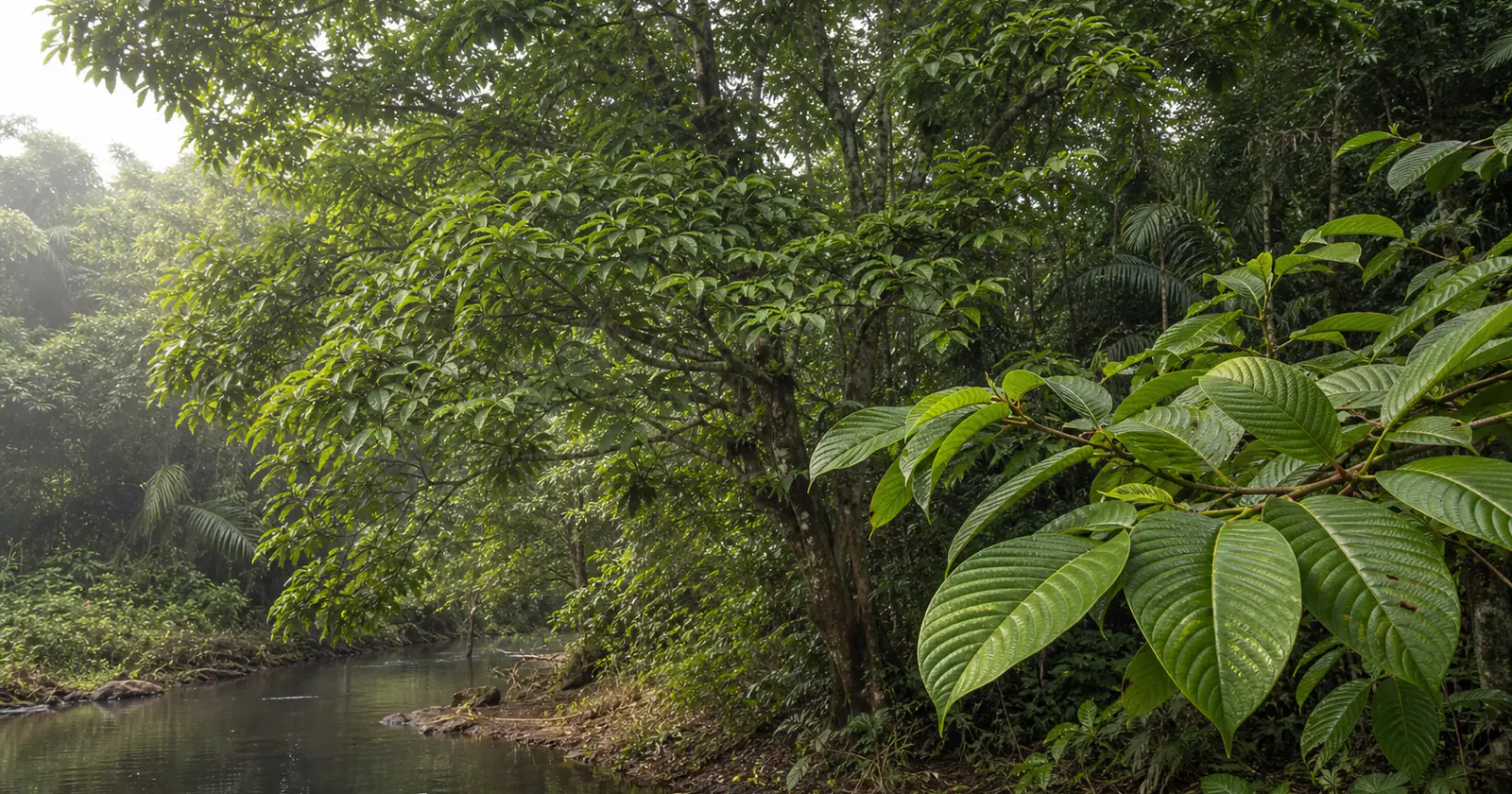
Botanical classification: kratom as a tropical tree
Mitragyna speciosa belongs to the order Gentianales and the family Rubiaceae—the same plant family as coffee (Coffea) and cinchona (Cinchona)23. Within the Rubiaceae, it is assigned to the subfamily Cinchonoideae and the tribe Naucleeae, which includes several other botanically and pharmacologically studied species28.
In its natural habitat, the tree can reach approximately 4 to 16 metres depending on location and environmental conditions, with still larger specimens reported occasionally13. Typical features include a generally straight trunk with pale grey-green bark, visible lenticels and a broad, densely foliated crown23.
The leaves are oval to broadly ovate, dark green and marked by pronounced, regularly arranged lateral veins12. Mitragyna speciosa remains evergreen in most tropical areas, but can behave as a facultatively deciduous tree in cooler or seasonally drier regions, shedding part of its foliage23.
Its flowers occur in spherical, yellowish inflorescences composed of numerous small flowers, often arranged in groups of three at a node28. They develop into capsule-like fruits containing many small, winged seeds that can be dispersed by wind and water23.

Natural range and habitat
Kratom originates in the humid lowlands of Southeast Asia and is reported as native to countries including Thailand, Malaysia, Indonesia, Myanmar, Cambodia, the Philippines and Papua New Guinea134. Its natural distribution is concentrated in regions with high year-round humidity, regular rainfall and nutrient-rich alluvial soils23.
Typical sites include floodplain forests, riverbanks, freshwater swamps and periodically inundated wetlands where groundwater saturates the soil for much of the year234. In these habitats, the trees can form dense stands. Their roots can contribute to riverbank stability and soil retention, alongside other wetland vegetation24.
Kratom is now cultivated outside its original range in some regions, including parts of the United States where outdoor or greenhouse conditions permit growth69. In temperate climates, however, the tree normally remains much smaller and is sensitive to cold and frost29.
Traditional and cultural significance
Historical and ethnobotanical sources describe kratom as part of everyday life in some rural Southeast Asian communities since at least the nineteenth century1610. Field studies from Thailand, Malaysia and Indonesia report that kratom leaves were familiar particularly among agricultural workers, fishers and plantation workers and became embedded in local practices16.
Beyond work, kratom appears in social and ritual settings in certain areas, including village gatherings, traditional ceremonies and animist practices610. The precise forms differ by region, community and historical period and remain subjects of ethnographic research610.
Traditional medical systems in several Southeast Asian countries also describe kratom within a much broader body of knowledge concerning regional plants1611. Historical use does not by itself establish clinical safety or efficacy. Contemporary health assessments and regulatory decisions rely increasingly on pharmacological and toxicological evidence712.
Constituents: alkaloids and other plant compounds
Scientific research has identified numerous secondary plant compounds in kratom leaves, including more than 40 indole and oxindole alkaloids712. Composition can vary substantially with genotype, geographical origin, harvest timing and post-harvest processing712.
The best-studied alkaloids include mitragynin—often quantitatively dominant in analysed samples—and 7-hydroxymitragynin, a compound and metabolite described as a potent µ-opioid receptor agonist in animal and in-vitro models71213. Other reported alkaloids include speciogynine, speciociliatine, paynantheine and numerous minor constituents whose pharmacology continues to be studied712.
Research using human and mouse liver preparations indicates that CYP3A enzymes convert mitragynin to 7-hydroxymitragynin, which can account for a substantial share of observed µ-opioid receptor-mediated effects in experimental systems1314. Mitragynin and some metabolites have also been investigated as functionally selective, or G-protein-biased, agonists. The implications for effects and adverse events remain an active area of research1314.
The leaves also contain chlorophyll, flavonoids, polyphenols, carbohydrates and minerals, as is typical of many evergreen tropical trees212. This plant matrix can affect extraction, stability and the measured availability of alkaloids and is therefore relevant to analytical and pharmacokinetic research712.
Legal classification and international discussion
Kratom’s legal status differs considerably around the world and can change515. Some jurisdictions control the plant, some regulate particular alkaloids or permit it subject to conditions, and others have no specific national classification515. A general article cannot establish the current law for a particular delivery address.
At international level, kratom has been discussed by the World Health Organization’s Expert Committee on Drug Dependence (ECDD)1516. Following a pre-review in 2021, the committee did not recommend a critical review leading towards international scheduling under the United Nations drug-control conventions. Kratom, mitragynin and 7-hydroxymitragynin remained under surveillance1516.
The European Union Drugs Agency (EUDA) and national authorities publish updated profiles summarising botanical information, known constituents, reported patterns of use, risks, market developments and legal issues157. Anyone considering an order must check the current rules that apply in the destination jurisdiction.

Current state of research
The number of scientific publications about kratom has grown markedly, particularly in pharmacology, pharmacokinetics, toxicology and possible interactions with other substances71217. Reviews report that kratom alkaloids interact with several receptor systems, including opioid, adrenergic, serotonergic and dopaminergic targets71217.
Clinical and observational research is examining reported patterns of use, participants’ stated motivations and adverse events observed in real-world settings1718. Pharmacokinetic models are also being refined to describe absorption, distribution, metabolism and excretion of mitragynin and related alkaloids in humans17.
International expert bodies emphasise the need for further high-quality research into long-term outcomes, interactions and risk profiles1517. A balanced assessment therefore requires continued attention to both scientific evidence and changing regulation.
Sources and scientific literature
- European Union Drugs Agency (EUDA) (2024). “Kratom drug profile”. https://www.euda.europa.eu/publications/drug-profiles/kratom_en
- University of Florida IFAS (2025). “Kratom: Botanical Insights and Cultivation Practices for a Conspicuous Medicinal Tree Species” (ENH1389/EP653). https://edis.ifas.ufl.edu/publication/EP653
- Britannica (2025). “Kratom (Mitragyna speciosa)”. https://www.britannica.com/plant/kratom
- Wikipedia. “Mitragyna speciosa”. https://en.wikipedia.org/wiki/Mitragyna_speciosa
- European Union Drugs Agency (EUDA) (2024). “Kratom drug profile” – legal status and health information. EUDA kratom profile
- StatPearls (2023). “Kratom”. NCBI Bookshelf. https://www.ncbi.nlm.nih.gov/books/NBK585120/
- McCurdy, C. R. et al. (2024). “An update on the clinical pharmacology of kratom: uses, abuse potential and future considerations.” Expert Review of Clinical Pharmacology, 17(2), 131–142. DOI: 10.1080/17512433.2024.2305798
- Royal Botanic Gardens, Kew. “Mitragyna speciosa Korth.” Plants of the World Online. Taxonomic record
- León, F. et al. (2009). “Phytochemical characterization of the leaves of Mitragyna speciosa grown in USA.” Natural Product Communications, 4(7), 907–910. DOI: 10.1177/1934578X0900400705
- Transnational Institute (2021). “Kratom in Myanmar and Southeast Asia: time for legal regulation”. https://www.tni.org/en/article/kratom-in-myanmar-and-southeast-asia-time-for-legal-regulation
- Jelsma, M. (2021). “Kratom: the creation of a threat.” TNI Drug Policy Briefing. Transnational Institute
- Flores-Bocanegra, L. et al. (2020). “The Chemistry of Kratom [Mitragyna speciosa]: Updated Characterization Data and Methods to Elucidate Indole and Oxindole Alkaloids.” Journal of Natural Products, 83(7), 2165–2177. DOI: 10.1021/acs.jnatprod.0c00257
- Kruegel, A. C. et al. (2019). “7-Hydroxymitragynine Is an Active Metabolite of Mitragynine and a Key Mediator of Its Analgesic Effects”. ACS Central Science, 5(6), 992–1001. https://doi.org/10.1021/acscentsci.9b00141
- WHO / ECDD (2021). “Pre-review report: Kratom (Mitragyna speciosa), mitragynine and 7-hydroxymitragynine”. WHO ECDD Kratom Report
- SupplySide (2025). “WHO foregoes recommending ‘critical review’ of kratom”. SupplySide article
- NIDA (2024). “Kratom” – Research Topics. https://nida.nih.gov/research-topics/kratom
- DEA (2020). “Drug Fact Sheet: Kratom”. DEA Kratom fact sheet
- ClinicalTrials.gov. “Real-world Momentary Assessment of Kratom Use Accompanied by Product Assays.” NCT05457803, status: Completed. Study record