
History of Kratom: From Traditional Use to Modern Research
The history of Mitragyna speciosa, better known as kratom, connects documented traditional use in Thailand and Malaysia with botanical, chemical and pharmacological research. The beginning of its use cannot be dated precisely from the available evidence; reliable historical and ethnographic records appeared much later12.
This article traces that development using primary literature, peer-reviewed studies and official sources. Reports of traditional practice are not presented as clinical evidence of efficacy. The text is provided for information only and does not recommend any use.
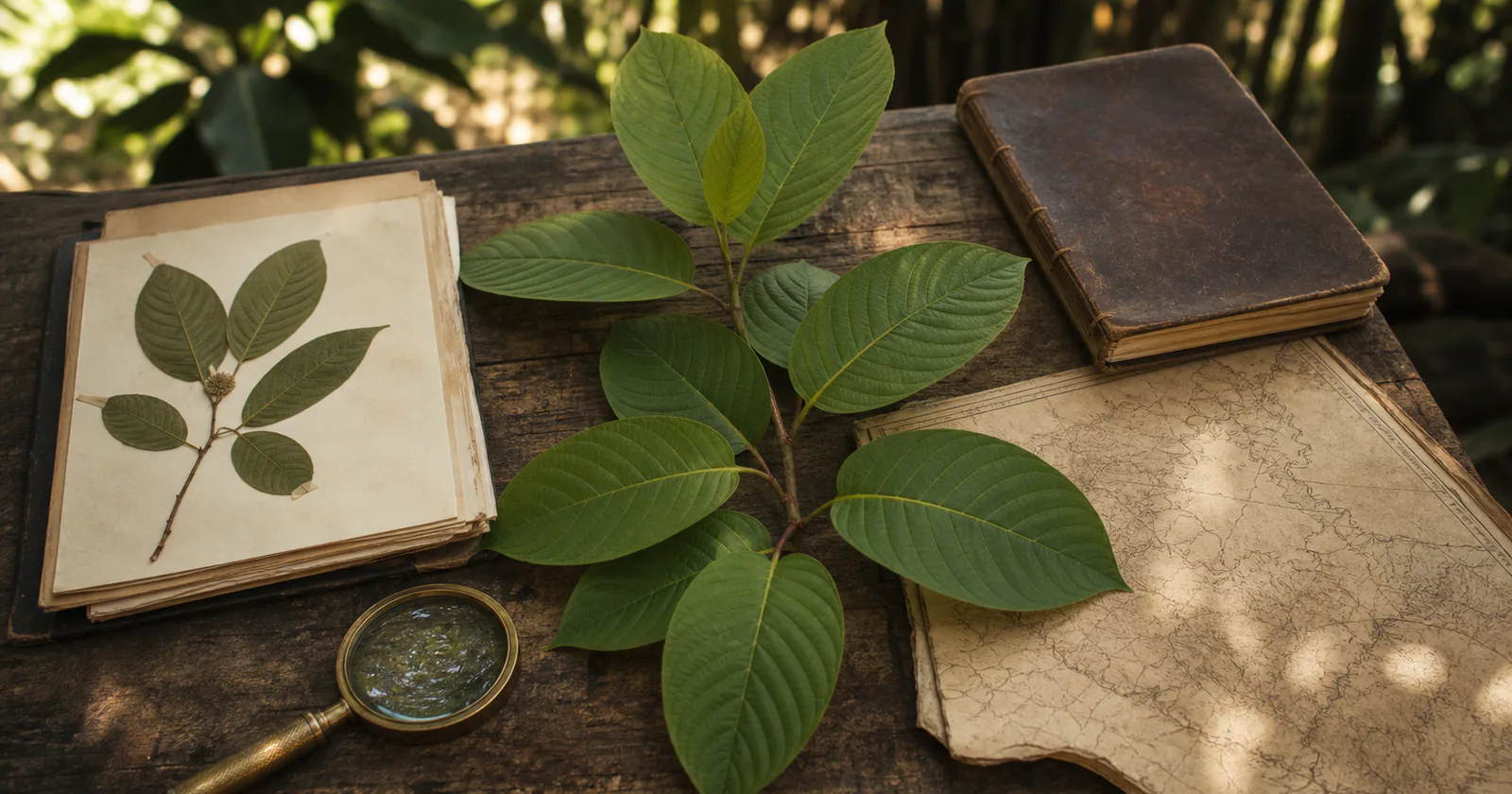
Traditional use in Thailand and Malaysia
Fresh leaves were documented as being chewed in Thailand, while decoctions were also consumed in the northern Malay Peninsula. In a 1975 Thai study, market gardeners, farmers and other labourers reported using kratom in connection with physically demanding work. The same source recorded traditional use for diarrhoea and as a substitute associated with opium use1.
In 1930, Burkill and Haniff recorded information collected from Malay healers and botanically identified specimens, including the use of pounded leaves as a wound poultice and a decoction in connection with opium craving2. A later cross-sectional survey of 136 active users in northern Malaysia documented self-reported ketum use to relieve opioid-withdrawal symptoms3. These ethnographic findings describe contexts of use; they do not establish efficacy or safety.
No sufficiently reliable primary sources could be assigned to the prehistoric, archaeological, spiritual and proverbial claims previously included in this article. Those claims have therefore been removed.

Early written and botanical documentation (1836–1897)
1836: A possible early reference
James Low described a Malay leaf called “Beak” on Penang that opium smokers used when opium was unavailable4. Because Low did not botanically identify it as Mitragyna speciosa, this is a possible early reference commonly associated with kratom—not an unambiguous first botanical record.
1839–1842: Korthals and the taxonomic reassessment
Pieter Willem Korthals introduced the genus Mitragyna in 1839. A modern nomenclatural analysis treats his plate 35, published in 1841, as the valid publication of Mitragyna speciosa Korth.5 Kew now lists this name with the publication year 1841, while Stephegyne speciosa, published in 1842, is treated as a synonym6. The genus name refers to the mitre-shaped floral stigma, not to the leaves.
1897: Haviland’s revision
George Darby Haviland treated the species as Mitragyna speciosa (Korth.) Havil. in his revision7. That author citation was widely used for many years. Following the reassessment of Korthals’s earlier plate, Kew’s current taxonomic backbone instead accepts Mitragyna speciosa Korth.56 The previous date of 1859 was incorrect.
Early chemical and pharmacological research (1921–1967)
1921: Isolation of mitragynine
E. J. Field reported the isolation and naming of mitragynine and mitraversine from Mitragyna material8. The paper is a primary phytochemical source; it does not provide a modern clinical assessment of kratom dependence.
1932: Early pharmacological studies
K. S. Grewal published systematic studies of mitragynine using biological preparations and animal models, as well as a separate early report on effects in humans910. These historical studies should not be equated with modern clinical evidence of efficacy or safety.
1963–1967: Structure and stereochemistry
Joshi, Raymond-Hamet and Taylor proposed the structure of mitragynine as 9-methoxycorynantheidine in 196311. In 1965, Zacharias, Rosenstein and Jeffrey confirmed the structure and stereochemistry of mitragynine hydroiodide by X-ray crystallography12. In the same year, an independent group led by Beckett investigated other alkaloids from the plant13; a study of the absolute configuration of the corynantheidine alkaloids followed in 196714. Beckett and Zacharias were therefore not members of one research team.
Thailand: From prohibition to a regulated legal framework
1943: Kratom Plant Act B.E. 2486
Thailand introduced nationwide controls on kratom, prohibiting cultivation, possession, sale and consumption15. A later official report by ASEAN-NARCO and Thailand’s ONCB identifies concern over government revenue from the opium trade as an important policy motive16.
1979: Category V
Under the Narcotics Act B.E. 2522, kratom was classified as a Category V narcotic. This classification remained in place until the kratom plant was removed from the narcotics list in August 202115.
Late 2000s and early 2010s: More intensive enforcement
UNODC documented an increase in kratom-related arrests in Thailand from 5,571 in 2007 to 13,134 in 2011, while seizures rose from 1.7 tonnes in 2005 to 23 tonnes in 201117. These figures demonstrate intensified enforcement during this period, not a uniform campaign from 2003 through 2018.
2019: Limited medical and scientific use
The Narcotics Act (No. 7) B.E. 2562 allowed licensed use of Category V narcotics, including kratom, for medical purposes and research from 19 February 201918. Kratom remained controlled; this was not general legalisation.
2021: Removal of the kratom plant from the narcotics list
The kratom plant was removed from Category V on 24 August 2021. Foods, herbal products, medicines and cosmetics containing kratom remained subject to the relevant product legislation15. “Removal from the narcotics list” is therefore more accurate than “complete decriminalisation.”
2022: Kratom Plant Act B.E. 2565
A dedicated legal framework took effect on 27 August 2022. Among other provisions, importing or exporting kratom leaves requires authorisation, and sales to people under 18 and to pregnant or breastfeeding women are prohibited19.
2024: Thai FDA guidance
On 4 September 2024, the Thai FDA published authorisation guidance for powdered kratom leaves and water- or ethanol-based extracts used in dietary supplements20. It specifies requirements under existing food law and was not a new Act.
WHO review: Surveillance rather than international scheduling
The 8th Working Group of the WHO Expert Committee on Drug Dependence recommended in April 2020 that kratom, mitragynine and 7-hydroxymitragynine be placed under WHO surveillance21. A pre-review followed at the 44th ECDD meeting in October 2021. The Committee found insufficient evidence to recommend a critical review of kratom and recommended continued surveillance22. This was neither a marketing authorisation nor a general finding that kratom is safe.

Modern scientific research (2000–2025)
Alkaloid research and metabolism
A 2019 preclinical study showed that mitragynine is converted to 7-hydroxymitragynine (7-OH) by CYP3A isoforms in mouse and human liver preparations in vitro. In the mouse model used, 7-OH contributed substantially to the opioid-receptor-mediated analgesic effect. These findings do not establish clinical efficacy or the same contribution to effects in humans23.
A 2020 in-vitro study also showed that 7-OH can be converted to mitragynine pseudoindoxyl in human plasma. In the opioid-receptor assays used, this compound was more potent than mitragynine and 7-OH; its actual contribution to effects in the human body has not been established clinically24.
Pharmacokinetics in humans
The first published human pharmacokinetic study appeared in 2015. It enrolled ten male regular kratom users, with the principal parameters evaluated for nine participants, which limits generalisability25. A 2019 systematic review evaluated 17 animal and human studies and identified substantial remaining gaps in the evidence26.
A randomised, double-blind, placebo-controlled dose-escalation study published in 2024 investigated mitragynine and 7-hydroxymitragynine after a single dose and after 15 daily doses of analytically characterised dried kratom leaf powder27.
Drug–drug interactions
Laboratory studies show that kratom alkaloids can affect cytochrome P450 enzymes28. In a controlled clinical interaction study, twelve healthy adults received a single tea preparation made from 2 g of kratom leaf powder. Exposure to dextromethorphan, a CYP2D6 probe, was not materially altered. For midazolam, a CYP3A probe, AUC increased by 39% and maximum plasma concentration by 50%. At this low single dose, the findings primarily indicate inhibition of intestinal CYP3A and cannot automatically be generalised to higher or repeated doses or to other products29.
Completed clinical and observational studies
Two studies previously described as ongoing have now been completed. The NIDA-led observational study NCT05457803 ended on 15 December 2022; the registry reports 396 participants30. The Phase 1 dose-escalation study NCT06072170 enrolled 40 participants and ended on 23 January 2024; results were posted to the registry on 29 September 202531.
A 2025 publication analysed 15-day ecological momentary assessment data from 357 regular kratom users in the United States. Bedtime kratom use occurred on 23.4% of observed days and was associated with an average of 13 additional minutes of self-reported sleep and a 5.93-point higher sleep-quality rating on a 0–100 scale. Because of the observational design, the findings do not establish causation or demonstrate that kratom is an effective sleep aid32.
Conclusion: Historical continuity, but limited evidence
Kratom has a documented traditional history in parts of Thailand and Malaysia, a repeatedly revised botanical naming history and a growing research base since the twentieth century. At the same time, many findings from preclinical models, small human studies or observational data cannot be directly generalised to clinical effects and risks. The WHO decision in 2021 was also a recommendation for continued surveillance, not a safety judgement22.
Sources and scientific literature
- Suwanlert, S. (1975). “A study of kratom eaters in Thailand.” Bulletin on Narcotics, 27(3), 21–27. PubMed
- Burkill, I. H. & Haniff, M. (1930). “Malay Village Medicine.” Gardens’ Bulletin, Straits Settlements, 6, 165–273. Biodiversity Heritage Library
- Vicknasingam, B., Narayanan, S., Beng, G. T. & Mansor, S. M. (2010). “The informal use of ketum (Mitragyna speciosa) for opioid withdrawal…” International Journal of Drug Policy, 21(4), 283–288. DOI: 10.1016/j.drugpo.2009.12.003
- Low, J. (1836). A Dissertation on the Soil & Agriculture of the British Settlement of Penang. Biodiversity Heritage Library
- Turner, I. M. (2018). “The importance of the plates in the Verhandelingen … for the nomenclature of South-East Asian plants.” Taxon, 67(3), 621–631. DOI: 10.12705/673.14
- Royal Botanic Gardens, Kew. “Mitragyna speciosa Korth.” Plants of the World Online. Taxonomic record
- Haviland, G. D. (1897). “A Revision of the Tribe Naucleeae.” Journal of the Linnean Society, Botany, 33, 1–94. DOI: 10.1111/j.1095-8339.1897.tb00653.x
- Field, E. J. (1921). “Mitragynine and mitraversine, two new alkaloids from species of Mitragyne.” Journal of the Chemical Society, Transactions, 119, 887–891. DOI: 10.1039/CT9211900887
- Grewal, K. S. (1932). “Observations on the Pharmacology of Mitragynine.” Journal of Pharmacology and Experimental Therapeutics, 46(3), 251–271. DOI: 10.1016/S0022-3565(25)07997-2
- Grewal, K. S. (1932). “The Effect of Mitragynine on Man.” DOI: 10.1111/j.2044-8341.1932.tb01062.x
- Joshi, B. S., Raymond-Hamet & Taylor, W. I. (1963). “Structure of Mitragynine (9-Methoxycorynantheidine).” Chemistry and Industry, 573. IAS Repository
- Zacharias, D. E., Rosenstein, R. D. & Jeffrey, G. A. (1965). “The structure of mitragynine hydroiodide.” Acta Crystallographica, 18, 1039–1043. DOI: 10.1107/S0365110X65002499
- Beckett, A. H., Shellard, E. J., Phillipson, J. D. & Lee, C. M. (1965). “Alkaloids from Mitragyna speciosa (Korth.).” Journal of Pharmacy and Pharmacology, 17(11), 753–755. DOI: 10.1111/j.2042-7158.1965.tb07599.x
- Lee, C. M., Trager, W. F. & Beckett, A. H. (1967). “Corynantheidine-type alkaloids—II: Absolute configuration of mitragynine, speciogynine, mitraciliatine and speciociliatine.” Tetrahedron, 23(1), 375–385. DOI: 10.1016/S0040-4020(01)83323-8
- Thai Food and Drug Administration, Narcotics Control Division. “Kratom – official regulatory history.” Official overview
- ASEAN-NARCO / Thailand Office of the Narcotics Control Board (2024). ASEAN Drug Monitoring Report 2024, pp. 57–58. Report (PDF)
- United Nations Office on Drugs and Crime (2013). World Drug Report 2013, p. 94. Report (PDF)
- Thailand Office of the Narcotics Control Board (2019). Thailand Narcotics Control Annual Report 2019, p. 40. Report (PDF)
- Thailand Office of the Council of State (2022). Kratom Plant Act B.E. 2565. Official English working translation
- Thai FDA Food Division (2024). “Authorisation guidance for kratom ingredients in dietary supplements”, 4 September 2024. Official guidance
- World Health Organization (2021). WHO Expert Committee on Drug Dependence: Forty-third report, TRS 1034. WHO report
- World Health Organization (2022). WHO Expert Committee on Drug Dependence: Forty-fourth report, TRS 1038. WHO report
- Kruegel, A. C. et al. (2019). “7-Hydroxymitragynine Is an Active Metabolite of Mitragynine and a Key Mediator of Its Analgesic Effects.” ACS Central Science, 5(6), 992–1001. DOI: 10.1021/acscentsci.9b00141
- Kamble, S. H. et al. (2020). “Metabolism of a Kratom Alkaloid Metabolite in Human Plasma Increases Its Opioid Potency and Efficacy.” ACS Pharmacology & Translational Science, 3(6), 1063–1068. DOI: 10.1021/acsptsci.0c00075
- Trakulsrichai, S. et al. (2015). “Pharmacokinetics of mitragynine in man.” Drug Design, Development and Therapy, 9, 2421–2429. DOI: 10.2147/DDDT.S79658
- Ya, K., Tangamornsuksan, W., Scholfield, C. N., Methaneethorn, J. & Lohitnavy, M. (2019). “Pharmacokinetics of mitragynine …: A systematic review.” Asian Journal of Psychiatry, 43, 73–82. DOI: 10.1016/j.ajp.2019.05.016
- Huestis, M. A., Brett, M. A., Bothmer, J. & Atallah, R. (2024). “Human Mitragynine and 7-Hydroxymitragynine Pharmacokinetics after Single and Multiple Daily Doses…” Molecules, 29(5), 984. DOI: 10.3390/molecules29050984
- Todd, D. A. et al. (2020). “Chemical composition and biological effects of kratom (Mitragyna speciosa): In vitro studies with implications for efficacy and drug interactions.” Scientific Reports, 10, 19158. DOI: 10.1038/s41598-020-76119-w
- Tanna, R. S. et al. (2023). “Clinical Assessment of the Drug Interaction Potential of the Psychotropic Natural Product Kratom.” Clinical Pharmacology & Therapeutics, 113(6), 1315–1325. DOI: 10.1002/cpt.2891
- ClinicalTrials.gov. “Real-world Momentary Assessment of Kratom Use…” NCT05457803, status: Completed. Study record
- ClinicalTrials.gov. “Adaptive Study to Evaluate … Single Ascending Doses of Kratom…” NCT06072170, Phase 1, status: Completed. Study record
- Mun, C. J. et al. (2025). “Is bedtime use of kratom (Mitragyna speciosa) a sleep aid or disruptor?” Experimental and Clinical Psychopharmacology, 33(5), 513–522. DOI: 10.1037/pha0000794