
Mitragynin and 7-Hydroxymitragynin: Key Kratom Alkaloids
Mitragynin and 7-hydroxymitragynin are among the most intensively studied alkaloids of the Southeast Asian plant Mitragyna speciosa. In preclinical studies, they substantially shape the pharmacological profile of kratom, particularly through interactions with µ-opioid receptors and other G-protein-coupled receptors123.
This article places both compounds in their botanical, chemical and scientific context. It explains why mitragynin is generally considered the principal natural marker compound in kratom leaves, why 7-hydroxymitragynin receives considerable attention despite its very low natural concentrations, and which questions remain open in research, analytical testing and regulation. The text is provided for factual information and does not contain consumption or use recommendations.
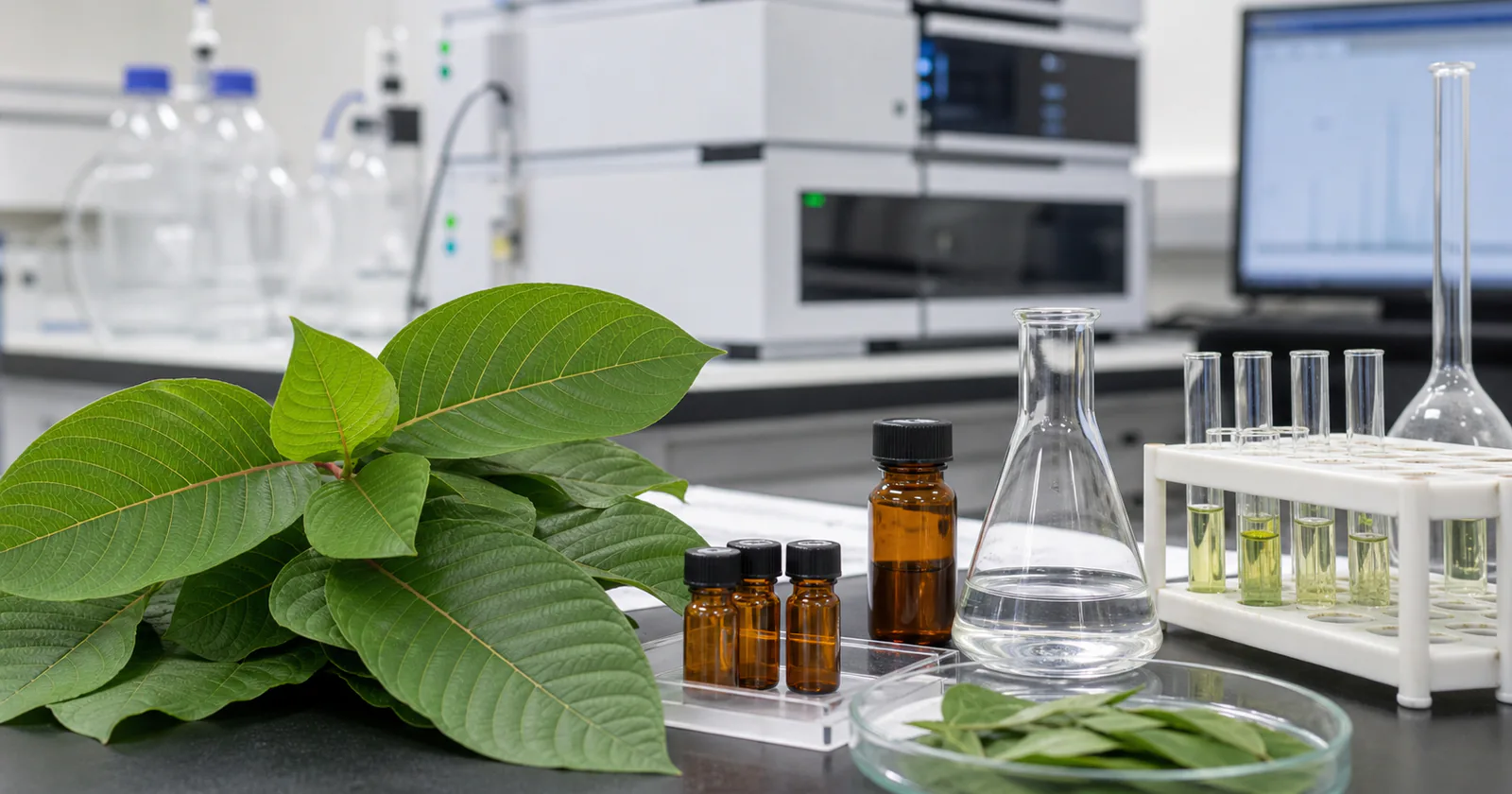
Botany and chemical diversity of Mitragyna speciosa
Mitragyna speciosa is an evergreen tree in the coffee family (Rubiaceae). The species is native to tropical regions of Southeast Asia, particularly Thailand, Malaysia and Indonesia24. Kratom is therefore botanically related to other Rubiaceae species, including coffee and various tropical trees.
The leaves contain a complex mixture of secondary plant compounds. Phytochemical investigations describe more than 40 distinct alkaloids, together with flavonoids, polyphenols and other constituents of the plant matrix24. This diversity is one reason why kratom cannot be reduced scientifically to a single constituent.
Quantitative analyses report that mitragynin accounts for the largest share of the alkaloid fraction in many samples and can exceed 60 per cent of total alkaloids in individual studies35. By contrast, 7-hydroxymitragynin is normally present in natural leaf material only in substantially smaller amounts, but is studied particularly closely because of its high pharmacological activity27.
Relative alkaloid levels can vary with geographical origin, genetics, cultivation conditions, time of harvest and processing35. Red, green and white vein types used in commerce are also frequently described as having different profiles, although these classifications are not always standardised consistently in scientific research.
Chemical structure: mitragynin and 7-hydroxymitragynin
Mitragynin belongs to the monoterpene indole alkaloids. Structurally, it has a complex corynanthe-type indole framework that has been linked biosynthetically to strictosidine and related precursors16. Its characteristic feature is the combination of an indole ring system and a terpenoid moiety, as found in many alkaloids from tropical plant families.
7-Hydroxymitragynin is an oxidised derivative of mitragynin. The defining difference is an additional hydroxyl group at the C-7 carbon17. This apparently small structural change affects the molecule’s three-dimensional conformation and is associated with greater affinity and efficacy at the µ-opioid receptor27.
This structural distinction is central to research: mitragynin is generally the quantitatively dominant alkaloid in plant material, while 7-hydroxymitragynin is much less abundant but is described as more strongly opioidergic in preclinical research27. Scientific and regulatory assessments are therefore increasingly distinguishing natural leaf material from products containing concentrated or isolated 7-OH fractions.
Occurrence and analytical determination
The chemical composition of kratom samples is not constant. Studies report differences between samples from Indonesia, Malaysia and Thailand, as well as between cultivation and processing methods35. This variability makes broad statements about “kratom” as a uniform product difficult.
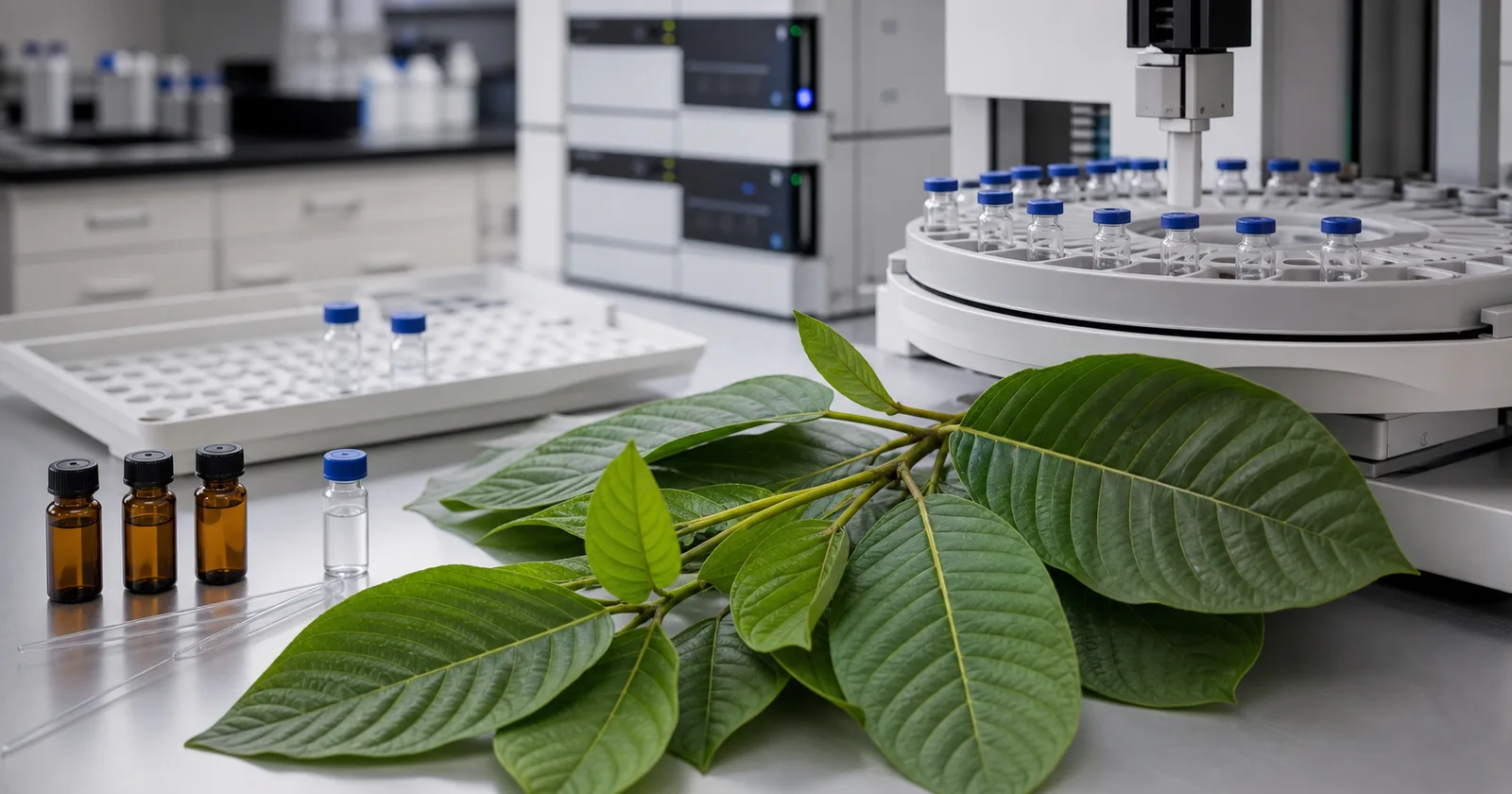
Validated analytical procedures have been developed to determine mitragynin and 7-hydroxymitragynin, including HPLC-UV methods for raw materials and processed products8. These methods make it possible to measure alkaloid concentrations reproducibly and compare samples.
Analytical testing is especially important because the concentration of individual alkaloids can be decisive for scientific assessment, quality control and regulatory discussion. A sample with a natural alkaloid profile must be considered chemically differently from a product to which isolated or highly concentrated individual substances have been added.
Pharmacology of mitragynin
Mitragynin displays a complex pharmacological profile in preclinical investigations. In-vitro studies suggest that mitragynin can act as a low-efficacy or partial agonist at the µ-opioid receptor and has lower affinity for δ- and κ-opioid receptors by comparison29.
Interactions with adrenergic α2 receptors and other targets in the central nervous system have also been described alongside the opioid system110. Different agonist or antagonist effects have been observed depending on the experimental model, making the overall picture more complex than that of a conventional single-target compound.
Animal studies describe antinociceptive effects mediated predominantly through opioid receptors, with possible contributions from non-opioid mechanisms211. Such findings are relevant preclinically, but cannot automatically be extrapolated to safe or effective use in humans.
Pharmacology of 7-hydroxymitragynin
Several preclinical studies describe 7-hydroxymitragynin as a substantially more potent µ-opioid receptor agonist than mitragynin27. Binding and functional studies show higher affinity and intrinsic activity at the µ-opioid receptor, while little affinity for adrenergic α2 receptors has been reported7.
In animal models, 7-hydroxymitragynin produces pronounced antinociceptive effects that can be reversed by opioid antagonists such as naltrexone27. Some studies also show that 7-hydroxymitragynin can substitute for morphine in particular behavioural paradigms210. These findings help to explain why products containing 7-OH receive particular regulatory scrutiny.
The distinction is important: 7-hydroxymitragynin can occur naturally as a minor component of the plant, but it can also be present in concentrated or isolated form in specialised products. This difference is highly relevant to risk and legal assessments.

Metabolism and pharmacokinetics
Mitragynin is biotransformed into several metabolites in the body. These include 7-hydroxymitragynin, 9-hydroxycorynantheidine, mitragynine acid and other conversion products45. LC-MS-based metabolism studies have identified 7-hydroxymitragynin as an oxidative metabolite of mitragynin4.
In a multiple-dose study in rats, mitragynin showed low renal clearance after repeated oral administration; less than one per cent of the dose was excreted unchanged in urine or faeces5. The principal metabolites in that study were mitragynine acid and 9-hydroxycorynantheidine, while 7-hydroxymitragynin was described as a minor metabolite5.
These pharmacokinetic data matter because the effects of a plant compound do not depend on the parent molecule alone. Absorption, distribution, metabolism and excretion help determine which compounds are present in the body, at what concentration and for how long.
Biosynthesis and the influence of cultivation conditions
Biosynthetic studies show that mitragynin is formed from strictosidine through several enzymatic steps16. These include reductases and an unusual SABATH-type methyltransferase whose activity can enable the formation of different mitragynin derivatives6.
Environmental conditions also influence the plant’s growth and alkaloid profile. Plant-physiology studies report that light intensity, cultivation practices and site conditions can alter leaf development and the concentration of individual alkaloids312. Different leaf areas and alkaloid concentrations have, for example, been observed under greenhouse conditions compared with outdoor conditions12.
In analytical practice, this means that origin, storage and processing must be considered when interpreting alkaloid measurements. A single value always describes one particular sample and does not automatically represent every product or plant in a category.
Discussion of potential benefits, risks and regulation
Several reviews summarise research on mitragynin and 7-hydroxymitragynin and discuss pharmacological potential alongside toxicological and regulatory questions2913. They regularly emphasise that although preclinical data consistently show interactions with opioid receptors, clinical questions concerning dose-response relationships, long-term consequences and interactions require further investigation.
The development of concentrated 7-hydroxymitragynin products is being watched particularly closely. Regulatory reports increasingly distinguish natural kratom leaf material from products containing isolated or highly enriched 7-OH. This distinction is essential to an evidence-based assessment because composition, potency and risk profile can differ substantially.
The principal point for readers is therefore one of context: mitragynin and 7-hydroxymitragynin are central subjects of research, but they represent different chemical and pharmacological aspects of kratom. Scientific statements should always distinguish natural plant material, extracts, isolated alkaloids and experimental models.
Sources and scientific literature
- Chen, W. et al. (2024). “Chemical, pharmacological properties and biosynthesis of opioid mitragynine in Mitragyna speciosa (kratom).” Current Opinion in Chemical Biology. https://linkinghub.elsevier.com/retrieve/pii/S1369526624000918
- Ahmad, K. et al. (2022). “Mitragyna Species as Pharmacological Agents: From Abuse to Promising Pharmaceutical Products.” Life, 12(2), 193. https://www.mdpi.com/2075-1729/12/2/193
- Kaur, A. et al. (2024). “A review on Mitragyna speciosa as a prominent medicinal plant based on ethnobotany, phytochemistry and pharmacological activities.” Natural Product Research. https://www.tandfonline.com/doi/full/10.1080/14786419.2024.2371564
- Philipp, A. A. et al. (2009). “Studies on the metabolism of mitragynine in rat and human urine using LC-linear ion trap MS.” Journal of Mass Spectrometry. https://analyticalsciencejournals.onlinelibrary.wiley.com/doi/10.1002/jms.1607
- Sharma, A. et al. (2024). “Multiple-Dose Pharmacokinetics and Safety of Mitragynine, the Major Alkaloid of Kratom, in Rats.” ACS Pharmacology & Translational Science. https://pubs.acs.org/doi/10.1021/acsptsci.4c00277
- Qu, Y. et al. (2022). “Biosynthesis of Kratom Opioids.” bioRxiv. https://biorxiv.org/lookup/doi/10.1101/2022.12.25.521902
- Obeng, S. et al. (2022). “Interactive Effects of µ-Opioid and Adrenergic-α2 Receptor Agonists in Rats: Mitragynine and 7-Hydroxymitragynine.” Journal of Pharmacology and Experimental Therapeutics. https://linkinghub.elsevier.com/retrieve/pii/S0022356524003513
- Brown, P. N. et al. (2018). “Determination of Alkaloids in Mitragyna speciosa by HPLC-UV.” Journal of AOAC International, 101(4), 964-965. https://academic.oup.com/jaoac/article/101/4/964-965/5654024
- Babalonis, S. et al. (2022). “Kratom as an opioid alternative: harm, or harm reduction?” American Journal of Drug and Alcohol Abuse. https://www.tandfonline.com/doi/full/10.1080/00952990.2022.2111685
- Prozialeck, W. C. et al. (2024). “Beneficial and Adverse Health Effects of Kratom: A Critical Review.” Toxicology Letters. https://linkinghub.elsevier.com/retrieve/pii/S0278691524004794
- Mohd Zain, N. et al. (2023). “Analgesic effects of mitragynine in an acute pain animal model.” Neuroscience Letters. https://linkinghub.elsevier.com/retrieve/pii/S0166432822005204
- Fudin, R. et al. (2022). “Plant growth and phytoactive alkaloid synthesis in kratom in response to varying radiance.” PLOS ONE. https://dx.plos.org/10.1371/journal.pone.0259326
- Kromphardt, K. et al. (2021). “Kratom abuse potential and neuropharmacology.” Frontiers in Pharmacology. https://www.frontiersin.org/articles/10.3389/fphar.2021.775073/full