
Botanical overview · Factual information
What is kratom?
Kratom is the common name for Mitragyna speciosa, a tropical tree in the Rubiaceae family. This page covers its botany, native range, leaf constituents and documented use as a dye plant.
Kratom at a glance
Botanical family
Rubiaceae – the same plant family as coffee and Cinchona.
Native range
Humid lowland regions in parts of Southeast Asia.
Growth form
An evergreen tree, commonly around 4–16 metres tall in its natural habitat.
Research
Mitragynine is usually the quantitatively dominant alkaloid in leaf material.
Botany
Classification and characteristic features
Mitragyna speciosa belongs to the Rubiaceae family, which also includes Coffea and Cinchona.
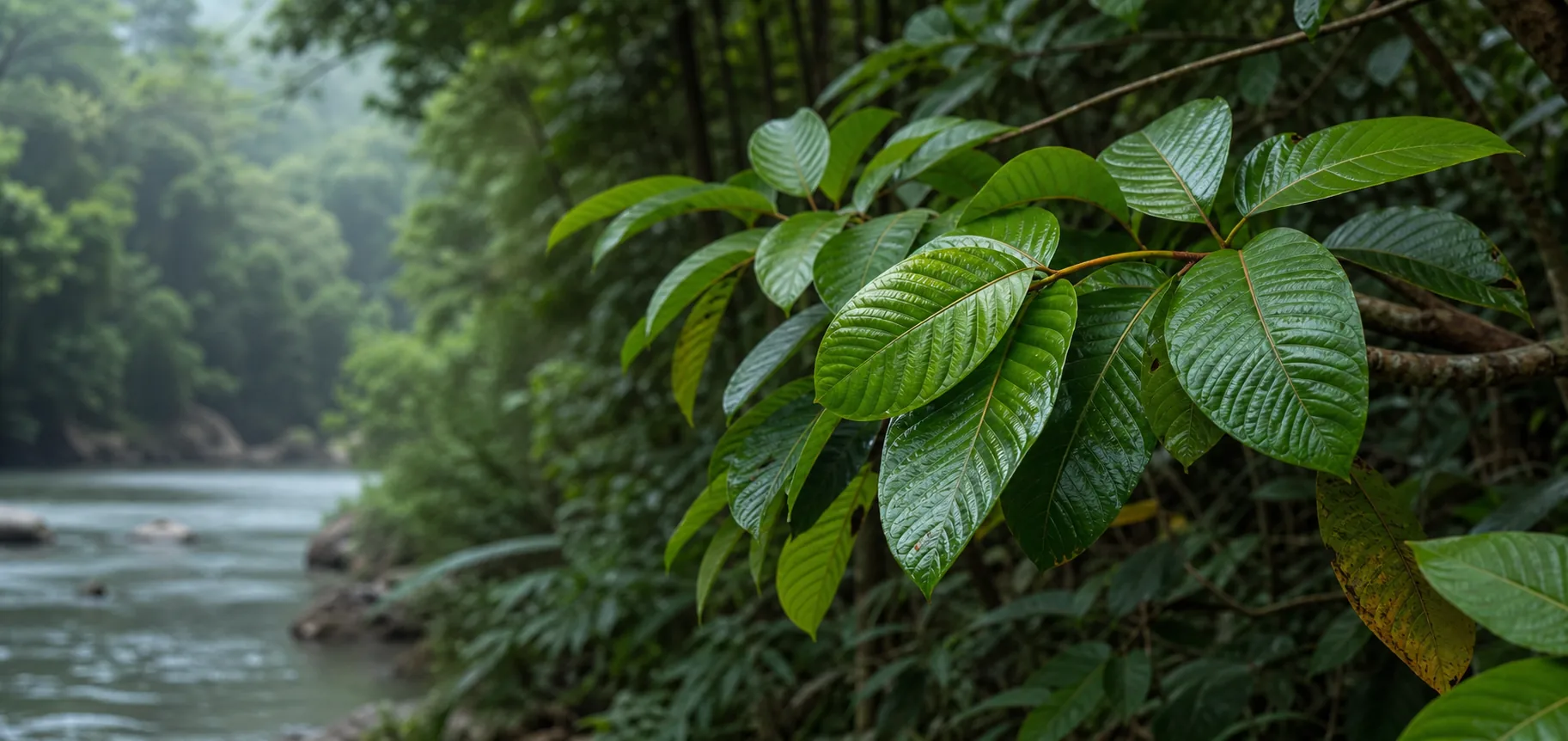
The evergreen tree generally has a straight trunk, grey-green bark and a broad crown. Its leaves are oval to broadly ovate, have smooth margins and show a distinct midrib with regularly arranged lateral veins.
Exact appearance can vary with age, location and growing conditions. The image therefore provides botanical context and should not be used as the sole basis for plant identification.
- Evergreen tree
- Oval, smooth-edged leaves
- Prominent lateral veins
- Broad leafy crown

Range and habitat
Humid lowlands of Southeast Asia
The species is native to humid lowland regions of Southeast Asia. Its range is described as including parts of Thailand, Malaysia, Indonesia, Myanmar, Cambodia and the Philippines.
Habitat
Riverbanks, floodplain forests and other humid or periodically flooded sites.
Climate
Year-round humidity and tropical temperatures support its growth.
Soil
Moist, nutrient-rich soils and a reliable water supply are typical.
Important leaf constituents
Leaf alkaloids studied in research
Botanical and chemical literature describes numerous indole and oxindole alkaloids in Mitragyna speciosa leaves. Their composition and relative amounts can vary with origin, harvest and processing.
Mitragynine
The usually quantitatively dominant and frequently studied alkaloid in botanical leaf material.
7-Hydroxymitragynine
A scientifically studied alkaloid and metabolite of mitragynine that typically occurs only at low to trace levels in natural leaf material.
Other alkaloids
The literature also describes compounds including speciogynine, speciociliatine and paynantheine.

Documented material use
Kratom as a dye plant
Older kratom leaves are documented in West Kalimantan as plant material used to dye weaving yarn. Depending on fibre, pretreatment and dyeing process, muted sage, grey, khaki and olive shades are realistic. Leaf pigments, tannins and polyphenols are more plausible contributors to these colours than the characteristic alkaloids.
Our German practical guide explains documented colour directions, natural fibres, mordants, test series and safe handling step by step.
Read “Kratom as a textile dye” (German guide)Naturalibre product notice
Keep botanical information and the product range clearly separate
Naturalibre kratom products are not sold as food or medicines and are not intended for consumption by people or animals. Product pages provide the current name, quantity, price, stock status and applicable use notice.